Archive · Accessories · Jewellery
Jewellerynecklaces, rings and earrings
The cheapest pieces in the catalogue and the ones most people actually wore. Also the ones that date a season best.
Costume jewellery is a catalogue thermometer. It changes every few weeks, costs little to produce and follows a trend with almost no lag, so a jewellery range tells you what was being worn at a precise moment better than any garment can.
This category keeps record cards for necklaces, ring packs and earrings. Several of these pieces were cited in Spanish fashion press for their price, which is why their original descriptions can still be documented today.
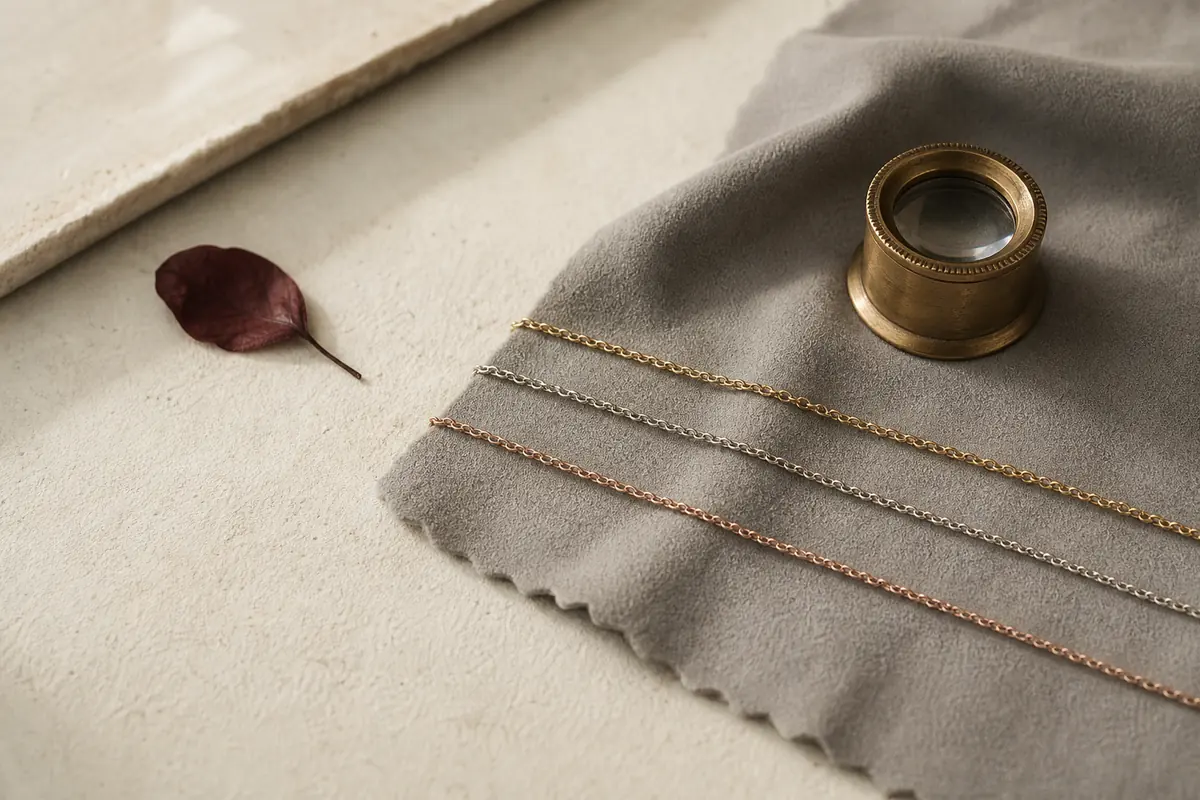
The four materials of the low bracket
Four materials cover nearly everything sold in this category, and each ages in its own way.
Plated metal
Brass or zamak with a gold or silver finish. This is the material of the metal necklaces and of most ring packs. Light, easy to form and cheap, with the known trade-off: the plating wears off by friction, starting inside the ring band and at the necklace clasp.
Resin and acrylic
Allows saturated colour and large shapes at almost no weight, which is exactly what a summer necklace needs. It takes water without complaint and scratches easily, so surviving pieces usually have a dulled surface even without heavy wear.
Cord, beads and ethnic elements
The catalogue ethnic necklace belongs to this family: textile cord, wood or synthetic bone beads and a metal element or two. It is the piece that ages best, because it has no finish to lose, and the one that places a season most clearly.
Pressed glass and rhinestone
Reserved for earrings and party pieces. It sparkles well when new and loses stones over time, because the adhesive dries out long before the glass deteriorates. When a stone is missing from an archive piece, that is almost always why.
The record cards
Two pieces from this category survive in the English archive with their reference and published description.
Half-moon necklace
View the card → Ref. 1150Feather earrings
View the card → EspañolSpanish version
Enter →Dating a piece without a reference
Three details do most of the work. The clasp comes first, because the small alloy lobster claw replaced the older spring ring at a fairly identifiable point. Then the chain gauge, which grew heavier through the late two thousands and thinned out again afterwards. And finally the bead drilling: machine-drilled holes are clean and identical, while the hand-finished beads used in cord pieces vary by a fraction of a millimetre from one to the next.
Repair or keep as it is
A clasp or a cord can be replaced and it is worth doing if the piece is otherwise complete. Plating cannot, and any attempt to re-plate over metal that has already oxidised gives a worse result than the worn original. As a rule, costume jewellery is conserved rather than restored.
Frequently asked questions
Why did ring packs come in three sizes?
Because low-bracket jewellery is not sized to order, and a pack of three solves the sizing problem by selling three at once. It also doubles the average ticket without doubling the cost, since all three come off the same die. It was standard practice at the time, not a quirk of this label.
Can a tarnished ring be saved?
Not really. Once the plating has gone through to the base metal, polishing removes what is left and the exposed brass will darken again within weeks. A piece in that state is documentation, not jewellery, and is best left alone.
How were these pieces described in the catalogue?
Briefly: a commercial name, a material note and a price. Where fashion press quoted a piece, the fuller description survives. Everywhere else the archive has the reference and the name, and it does not extend either with detail it cannot support.
Do the English and Spanish cards describe the same pieces?
The numbering is shared, so a reference points to one piece in both languages. The English archive keeps the accessories cards; the Spanish one also keeps the clothing categories, so the two are complementary rather than duplicates.