Archive · Accessories · Barcelona
Accessoriescostume jewellery and small goods
Necklaces, rings, hats and bags. The section where a high-street shop makes its margin, and where the material tells the truth.
Accessories were the second large block of the catalogue and, in a shop of this kind, the profitable one. A piece of costume jewellery is bought on impulse, needs no fitting room, has no sizes and is rarely returned. That allows a wide range on a small investment and a much faster turnover of new lines than clothing ever permits.
The English archive keeps this section with two subcategories: jewellery, covering necklaces, rings and earrings, and small goods, covering hats, bags and minor leather items. Between them they held the cheapest pieces in the catalogue, almost all of them under twenty-five euros.
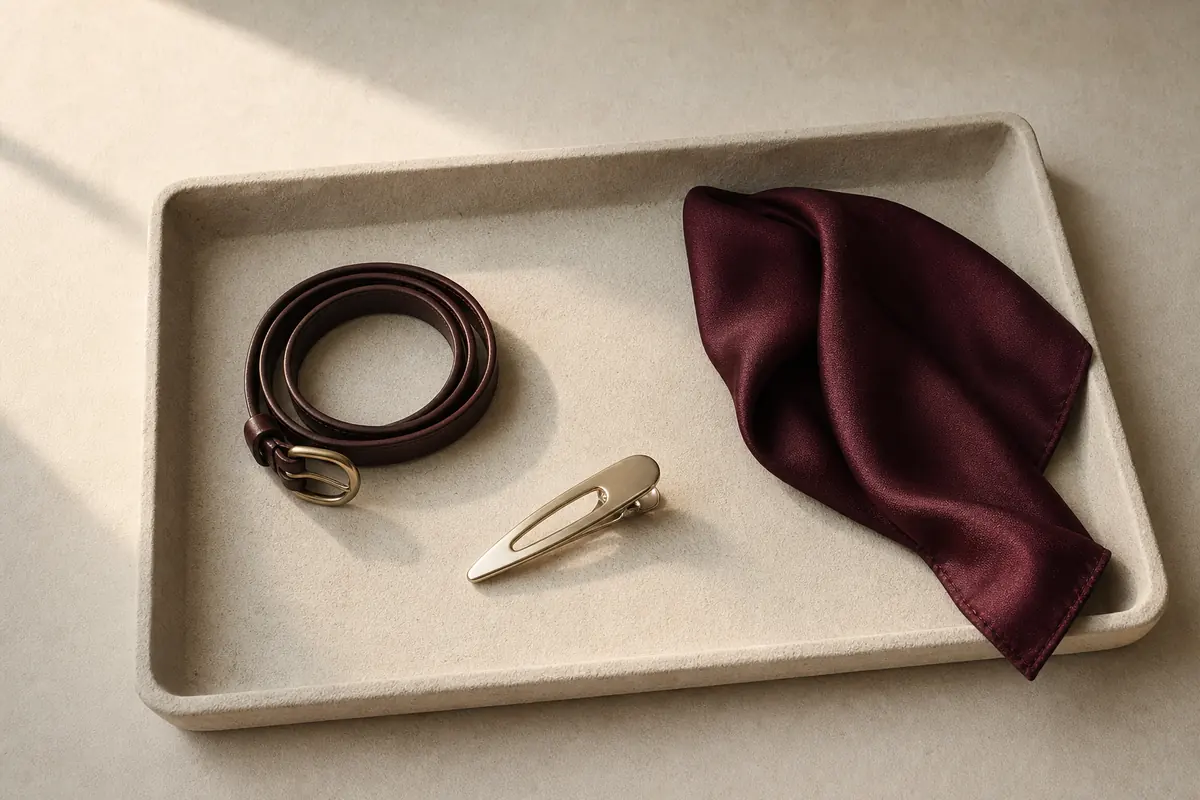
What a low price actually allows
In accessories the price tells you almost everything about the material, and it is worth knowing how to read it before judging an archive piece by fine-jewellery standards.
Jewellery under ten euros
Brass or zamak with a plated finish, textile cord, acrylic or pressed glass. The plating decides the useful life: it lasts somewhere between a few months and two years of frequent wear, and it goes first at the points of friction. That is not a manufacturing fault but the limit of the material at that price.
Small goods between ten and twenty-five euros
Synthetic leather, polyester lining, alloy hardware. At that cost the construction is sound but the corners and the strap wear first, because they carry the tension. A bag from this bracket, looked after, survives two or three seasons of daily use.
The knitwear exception
A ribbed wool-blend hat at eight euros is, technically, the best buy in the catalogue. Chunky rib does not depend on fine finishing, it ages well, and almost all of the cost sits in the yarn, so at a low price the maker cuts quantity rather than apparent quality.
How pieces are dated
Without a reference number, a piece of costume jewellery is placed by three signals. Size first: large volumes on short chains belong to the late two thousands, minimal pieces on long chains to the decade after. Then the metal finish, because bright gold and mirror silver alternate in cycles of roughly five years. And finally the clasp, the detail nobody bothers to disguise, which is why it dates a piece so reliably.
Storing accessories from this period
Plated jewellery is kept dry, separated and away from perfume and hairspray, which attack the finish faster than anything else. Synthetic leather does not take conditioner the way real leather does, but it does crack with heat, so an interior cupboard beats a sunny shelf. Knitwear is folded with cedar nearby and never hung.
Frequently asked questions
How do you clean plated jewellery?
With a dry, soft cloth and nothing else. No water, no soap, no jewellery dip, because all of them reach the plating before they reach the dirt. If a piece has been in contact with cream or perfume, wipe it the same day: the residue is what starts the oxidation underneath.
Why do these necklaces tarnish?
Because the plating is a layer a few microns thick over a base metal that oxidises on contact with sweat, perfume and damp. Once that layer breaks, oxidation spreads from the break. It cannot be reversed at home, and aggressive polishing removes whatever plating is left.
Do the archived pieces have any market value?
As material, no: plated brass and pressed glass have no recovery value. As catalogue documentation they are of interest, in the same way a season leaflet or a colour card is. The archive keeps them for the second reason, not the first.
How many references did the section hold?
Somewhere between one hundred and one hundred and fifty active lines across both subcategories, peaking in spring and at Christmas. That is more than clothing carried, because the low unit cost allowed a lot of visible variety without tying up much money.